Archaeological Institute of America
American Journal of Archaeology
Home Subscribe Submissions AJA Society Help Contacts Search
Current Table of ContentsPast IssuesOnline ReviewsImage GalleriesSupplementary DataAJA Online Forum
Current Issue 112.2 (April 2008)
Main Image

Cynthia S. Colburn suggests that eastern imports in Prepalatial Crete were used by the Cretan emergent elite to distinguish themselves from the general population of the island and, perhaps, to align themselves with the ruling classes in Eastern centers.

As one example of this, she points to fresco images that show the use of exotic imports as body adornment. While Colburn admits that this evidence is somewhat speculative because all the depictions come from later periods, she believes it should not be omitted, especially in view of the lack of contemporary iconographical evidence. In the frescoes from Akrotiri on Thera, for example, several figures wear gold and silver necklaces, bracelets, armlets, and earrings, as well as necklaces and bracelets with blue or red beads. One of the Akrotiri frescoes, shown here, depicts an enthroned goddess or priestess who is flanked by a griffin and a blue monkey and who wears a red-beaded hair ornament and necklaces; some of the latter incorporate bird pendants similar to one of chalcedony found in Tomb IV/V/VI at Mochlos. Read More
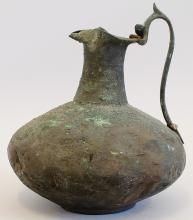
David Ben-Shlomo, Itzhaq Shai, Alexander Zukerman, and Aren M. Maeir analyze changes in cooking vessels during the Iron Age in Philistia and the southern Levant, emphasizing morphology, manufacturing technology, and regional distribution of cooking jugs.
Lori Khatchadourian discusses the intellectual history of classical archaeology in the South Caucasus with a general regional account in the decades before World War II and a more focused analysis of developments in the Republic of Armenia in the following years.
James P. Delgado and colleagues present short reports on nautical and maritime archaeology projects conducted in the 2006 and 2007 field seasons.
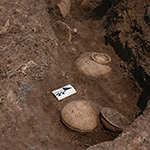
Peggy Sotirakopoulou, Pat Getz-Gentle, and Colin Renfrew discuss, in a three-article Forum, the Keros Hoard, an extensive group of Early Cycladic objects, mostly fragments of marble figurines, allegedly from Kavos, on the island of Keros, a site that had suffered intensive looting before the first rescue excavations were conducted in 1963.

Electronic Subscription

Download Articles


Upcoming Articles

Andrew Stewart addresses the problem of the so-called Severe Style from an archaeological perspective by focusing on sculptures found, or allegedly found, in Persian destruction contexts or directly associated with the Persian and Carthaginian invasions.

Nancy T. de Grummond explores the imagery of Etruscan lunar divinities and argues for recognition of a moon goddess at Pyrgi named Catha.

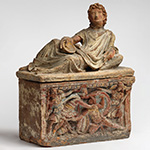
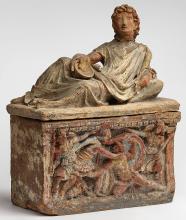
Richard De Puma examines an alleged tomb group acquired by the Metropolitan Museum of Art in 1903 and suggests the likely owner and occupant of the tomb.

Ingrid Edlund-Berry considers the so-called Tuscan temples and their role as statements of religious and political dominance within Etruria and central Italy.

Rex E. Wallace argues that the muluvanice inscriptions on bucchero pottery in an as yet unidentified building at the Etruscan site of Poggio Civitate (Murlo) suggest that the building functioned as the public center of the site.

Julie Laskaris discusses the Etruscan and Italic celebration of nursing mothers, as evidenced by their art, literature, and medical theories and practices.

Patricia Maynor Bikai et al. propose that a building complex at Beidha, Jordan, which was abandoned shortly after it went into use, was erected to extol tryphé, or living in luxury, and linked the Nabataean royal house to Dionysos and Alexander.

Steven Savage et al. report on the 2007 season of fieldwork in Jordan.

Eurydice Kefalidou reexamines the inscriptions on the Argonauts’ Krater and proposes that one of its figures is the first known representation of Queen Kleite, wife of Kyzikos, who played a role in the Argonauts’ adventure as described by Apollonios Rhodios.

About the AJA

The American Journal of Archaeology is one of the world's most distinguished and widely distributed classical archaeology journals. It was founded in 1885 and continues to devote itself to the advancement of archaeological studies and to the promotion of interest in them. Circulation of the AJA reaches 53 countries and almost 1,000 universities, learned societies, departments of antiquities, and museums. It is published quarterly in both print and electronic (PDF) formats in January, April, July, and October and is available through membership in the Archaeological Institute of America or by subscription.