Home American Journal of Archaeology Archaeological Institute of America
American Journal of Archaeology

Search

Main menu

  • Home
  • About
  • Subscribe
  • Advertise
  • Permissions and Reprints
  • Contacts
  • Current Table of Contents
  • For Authors
    • Submission Guidelines
    • Submit Online
    • AJA Abbreviations
    • Author Documents
  • For Students
    • General Resources
    • Academic Resources
    • Careers
    • Project Websites
    • Blogs
    • Multimedia
  • Author Bios
  • Archive
    • Past Issues
    • Article Search
    • Back Issue Sales
  • Open Access
    • Book Reviews
    • Museum Reviews
    • Supplementary Content
    • Image Galleries
    • Print-Published Content

Nautical and Maritime Archaeology, 2006–2007 Seasons

View abstract

Click the thumbnails to see larger images.
Unless otherwise noted in the figure caption, author of the article holds copyright.

1
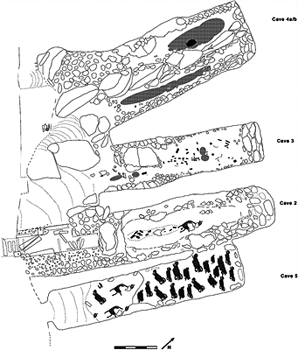
Fig. 1. Site plan of Mersa/Wadi Gawasis.
2
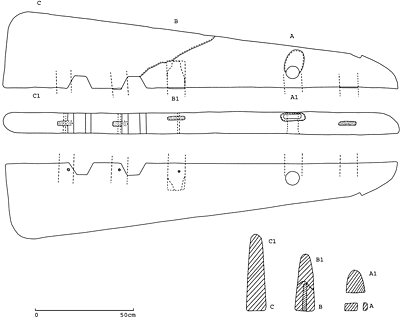
Fig. 2. Blade 2, excavated at the entrance to Cave 2 at Mersa/Wadi Gawasis, associated with early New Kingdom pottery.
3
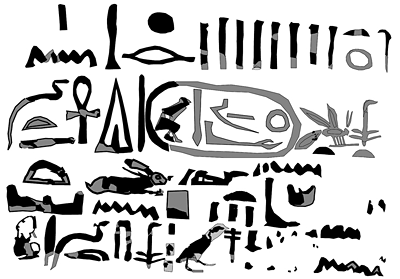
Fig. 3. Hieroglyphic inscription on Cargo Box 2 from Mersa/Wadi Gawasis, with the cartouche of King Amenemhat IV of the 12th Dynasty, below which is the text describing the box's contents (The wonders of Punt).
4
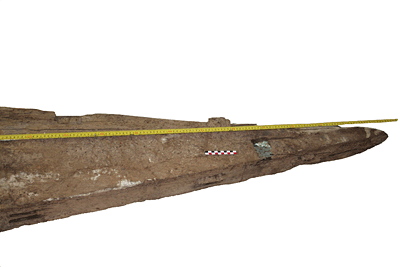
Fig. 4. The tapering end of a knife-shaped cedar plank recovered in 2006 at Mersa/Wadi Gawasis. Visible on its outer face is a through mortise that contains significant remnants of a copper alloy ìstrapî that would have fastened to an adjoining timber. Along each edge are several paired mortise-and-tenon joints, two of which still contain their original tenons.
5
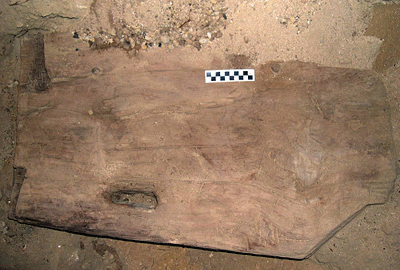
Fig. 5. This wide and thick cedar timber, found inside a cave at Mersa/Wadi Gawasis in 2007, remains to be fully excavated. Both ends have clearly been reworked. The left end of the upper face displays parts of two dovetail-shaped open mortises. A through mortise visible near the lower edge retains traces of a copper alloy ìstrap.î Two round peg ends can be seen toward the upper edge.
6
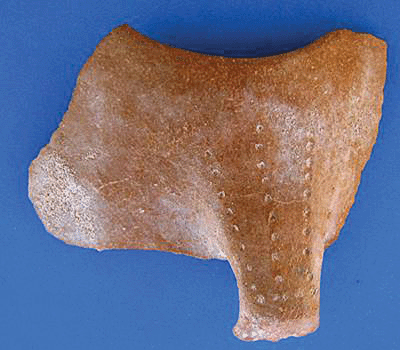
Fig. 6. A Sabir culture sherd from Aden region, excavated at Mersa/Wadi Gawasis.
7
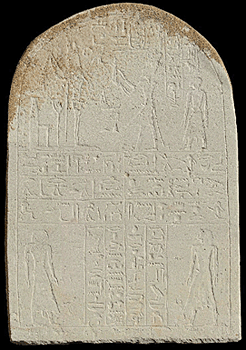
Fig. 7. Stela 5 from Mersa/Wadi Gawasis, with an inscription mentioning two expeditions to Punt and Bia-Punt during the reign of Amenemhat III (12th Dynasty), led by two brothers, Nebsu and Amenhotep.

DOI: 10.3764/ajaonline1122.Delgado.suppl

  • Home
  • About
  • Subscribe
  • Society for the AJA
  • For Authors
  • Open Access
  • Archive
  • For Students
  • AJA e-Update
  • RSS Feed
  • Permissions and Reprints
  • Advertise
  • Contacts
  • Privacy Policy

© 2012 Archaeological Institute of America